The mortgage
The mortgage on the Loman house is the material anchor of Willy Loman's lifelong pursuit of the American Dream, a twenty-five-year obligation that he treats as both a measure of his worth and a promise of future release. It is the one concrete achievement he can point to after decades of selling—a house that he has repaired, remodeled, and rebuilt with his own hands, and that he hopes will finally prove he has added up to something. Yet the mortgage's final payment arrives not as a celebration but as a bitter irony, paid on the very day of his funeral, when there is no one left to inhabit the home he fought to own.
The Weight of the Mortgage
Willy Loman has carried the mortgage for twenty-five years, a span that reaches back to when his son Biff was nine years old. The house was bought in a time of greater promise, when the family still seemed full of possibility and the surrounding neighborhood had not yet been hemmed in by apartment buildings. Over the decades, Willy has poured his labor into the property—cement, lumber, a new porch, an extra bathroom, a garage—transforming the house into a monument of his physical effort. He takes pride in the fact that "there ain't a crack to be found in it any more," as though the soundness of the structure could compensate for the fragility of his life. The mortgage is not merely a debt; it is the central financial drama of his existence, the one large obligation that, once cleared, he believes will set him free.
The Final Payment and Its Irony
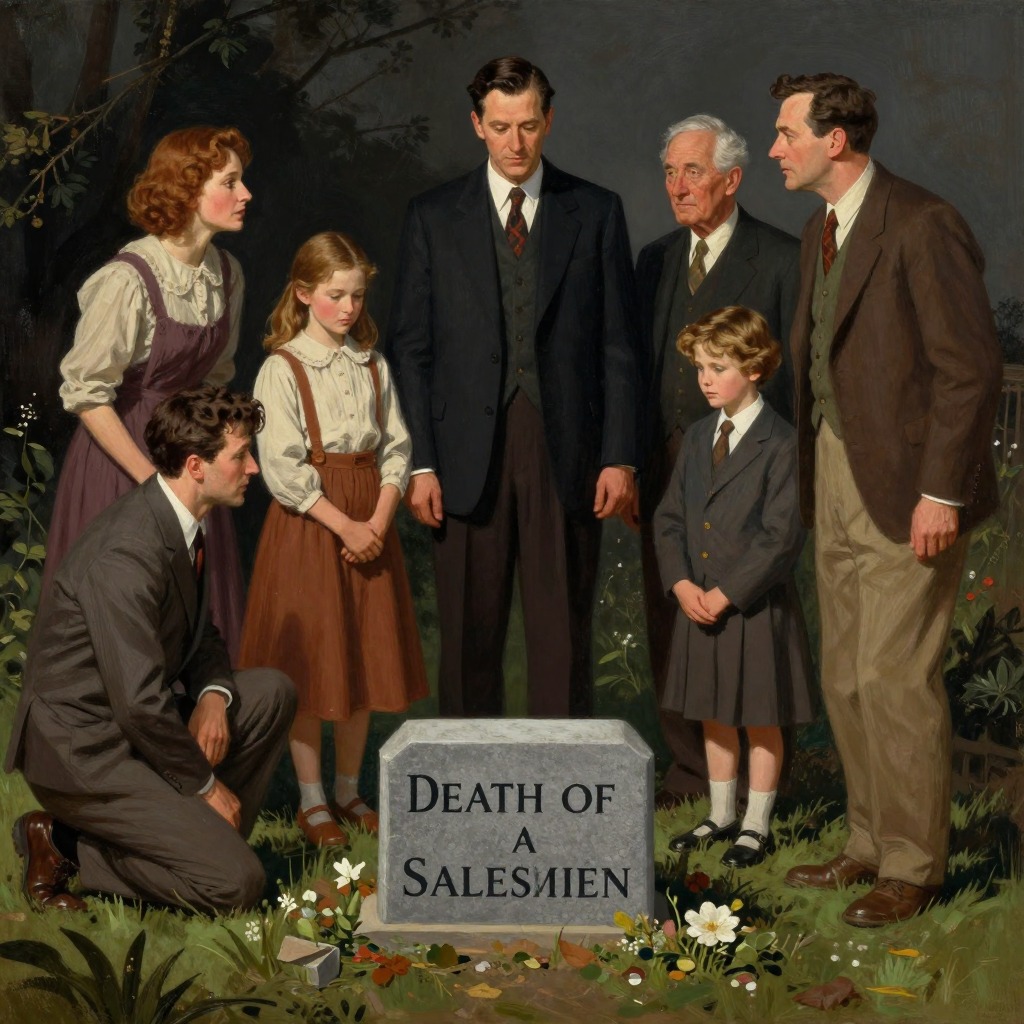
In the Requiem, Linda Loman reveals the cruel timing of the mortgage's conclusion. "First time in thirty-five years we were just about free and clear," she says at Willy's graveside. "I made the last payment on the house today. Today, dear. And there'll be nobody home." The word "free" recurs as she sobs—"We're free and clear. We're free"—but the freedom is hollow, purchased at the cost of her husband's life. The house, which was supposed to be the reward for a lifetime of labor, stands empty of the family it was meant to shelter. The mortgage's payoff, which Willy had anticipated as the moment when he could finally rest, arrives as a posthumous accounting, a financial liberation that no one is left to enjoy.
The Mortgage as a Measure of Worth
Throughout the play, Willy measures his success and failure against the mortgage. He speaks of it as an accomplishment—"To weather a twenty-five-year mortgage is—"—and Linda completes the thought: "It's an accomplishment." Yet the achievement is undercut by his awareness that the house will pass to strangers. "Some stranger'll come along, move in, and that's that," he laments. His deepest wish is that Biff would take the house and raise a family there, turning the paid-off mortgage into a legacy rather than a transaction. The mortgage thus becomes a symbol of Willy's larger predicament: he has spent his life working toward a goal that, once reached, reveals itself as empty. The house is paid for, but the family it was meant to hold has scattered, and the man who labored to own it is dead by his own hand.
The Mortgage and the Insurance
The mortgage is also entangled with Willy's suicide plan. He sees his life insurance policy—worth twenty thousand dollars—as the means to finally provide for his family, to give them the financial security that the mortgage's final payments have strained. The insurance money would pay off the house and leave something for Biff, transforming Willy's death into a kind of belated success. Linda, aware of the rubber pipe he has attached to the gas heater, lives in dread of this outcome, but Willy presses forward, convinced that his death will be worth more than his life. The mortgage, in this sense, is not just a debt to be cleared; it is the justification for his final act, the proof that even in dying he can be a provider.
Thematic Significance
The mortgage encapsulates the play's central critique of the American Dream: the promise that hard work and material accumulation will yield happiness and security. Willy Loman has done everything the dream requires—he has bought a house, made the payments for twenty-five years, and maintained the property with his own hands—yet the reward is not freedom but a funeral. The house, which should be a sanctuary, becomes a cage; the mortgage, which should be a path to independence, becomes a treadmill that ends only when the man himself is gone. Linda's final cry—"We're free"—is the play's most devastating irony, a liberation that comes too late and means nothing. The mortgage, like the dream it represents, is a promise that can never be fulfilled in life, only settled in death.